Translate

Tuesday, January 7, 2014

Short Test - 2013 Toyota Camry LE


Vanilla.

It's the flavor of ice cream that makes no bones about being one of the top flavors you can order at your local ice cream shop. It's neither flashy nor does it call attention to itself but it satisfies the masses by being simply...ice cream. When something just works, no one argues against it and that my friends, is the essence of vanilla ice cream. As far as cars go, the Toyota Camry is the vanilla flavor of the mid-sized car segment (yes, yes, not a very exciting segment...the vanilla segment if you wish). Though some manufacturers try to at least make their competing products interesting (read Hyundai Sonata, Mazda 6 etc), when something is as successful at being plain and inoffensive as the Camry, you don't mess with the formula, which is why for years and years, Toyota has sold boatloads of the things. As a matter of fact, the Camry is, and has been, the best-selling mid-sized car for a number years (only losing out to the cross-town rival Honda Accord one or two of those years). Why is the Camry so successful you ask? Just ask your neighbor...or your mother...or your aunt.


The Toyota Camry was most recently redesigned for the 2012 model year and, rather than do a ground-up change of things, Toyota left the essential parts alone and decided to spice up the exterior a bit (a dash of sprinkles?). Gone is the pudgy, rounded look of the 2011 car, giving way to sharper edged sheet metal with creases and angles. The face is just ever so slightly more aggressive while still very much approachable. The body sides are plain and void of any styling while the rear end features scimitar-shaped brake lights. The overall look is different enough from the outgoing Camry to elicit some visual interest (per CEO Akio Toyoda's mandate to invoke "emotion" into Toyota's products) but safe enough that the familiar Camry DNA is undiluted. Inside the cabin, all feels intimately familiar. My family has had Toyota products for years and a two-generations-down Camry (codename XV30) was very recently gracing our garage so it's no wonder. The interior was roomy, spacious and airy with good quality materials on all the touch points. The front seats were comfortable with good support for long distance cruising though, like our old Camry, lacked lateral support. The rear space was also plenty roomy featuring loads of leg space and head room. If the new Corolla is any indication, Toyota knows how to make the most passenger room for a given space.


Powering my LE tester was Toyota's ubiquitous 2.5L inline four cylinder hooked up to a six speed automatic. The engine's adequate 170hp and 178lb-ft of torque won't set any records and a look at the Camry's competitive set indicates the base four banger is well, competitive (a robust 268hp 3.5L V6 is uptick option). On my short test, the Camry offers no surprises. Like that toaster you simply put your bread in and engage the lever, the Camry drives in a similar fashion. The ride is comfortable and smooth, though body roll was extreme during some vigorous driving. The all-strut suspension has been a Camry hallmark for many years and aids making the ride very supple. The transmission would rather you didn't ask for a kickdown from the fuel sipping 6th gear for a lower one when passing and hestitates, although the engine offers enough go to suit the vast majority of the people buying this car. Noise is mostly subdued with the engine only making its presence known whenever the transmission does decide to kick down a gear or two after pinning the throttle. Again, settling into the driver's seat was instantly familiar. This isn't a car for enthusiasts or people who relish the drive between points A and B. Like the Corolla, the Camry aims to be as painless and unobtrusive as possible, scooting you to your destination with little fanfare. It is a car that does very little to call attention to itself....or you for that matter.


The center stack is not stylistic in that Hyundai-Sonata sense, but all the controls are logically placed and easily manipulated from either front seat. My LE tester offered a 6" touchscreen to access the infotainment system. Bluetooth (both phone and audio streaming) as well as AM, FM and a CD player but Toyota's EnTune system is available on higher trims. The material quality throughout the cabin is indicative of Toyota's legendary reliability as not many surfaces I touched were offensive, except maybe for the strip of plastic around the touchscreen that exhibited a sense of cheapness.


In all, the Camry is a pretty good car and will satisfy the needs of the many. It is an honest, no-brainer buy for someone who wants the space of a midsize car with good fuel economy and Toyota reliability. As someone who has lived with Toyotas for most of his life, I wouldn't hesitate to recommend the Camry. Plus, with other variants on offer (a sporty SE model for the man who wants a good drive without upsetting the wife and a hybrid model for tree huggers who need something larger than a Prius) the Camry does most things well. Sure, you can't really go wrong the reliability of vanilla ice cream, but there are simply too many other excellent flavors to ignore.

Special thanks to the R.P.E. Foundation for aiding in facilitating this review!

Monday, October 14, 2013

First Impressions - 2015 Cadillac Escalade


It's been over 10 years since Lil Wayne first coined the term 'Bling Bling' and the related song has been a hit ever since. So much so that many dictionaries now officially recognize the word, defining it as 'flashy, ostentatious, especially relating to jewellery'. OK so maybe Weezy didn't officially invent the word but he made the term popular in hip hop circles, even extending the term to refer to automobiles.

Consider the Cadillac Escalade the automotive definition of bling-bling.

Since its introduction, the Escalade has ruled the roost as far as being the primary vehicle for rap moguls and reality stars. Dripping with chrome and personality, the Escalade is a worthy contemporary to tell the world you've made it in ostentatious and excessive style when a Range Rover just won't cut it. To keep the Escalade at the top of its game, Cadillac has redesigned its moneymaker and instead of messing with success, GM's luxury arm sought to address shortcomings of the GMT900 model and further distance it from its YukoTahBurban siblings.


Based on the brand new GMT K2XX platform that also forms the foundations for the new Silverado/Sierra trucks, the new Escalade still sports the same bold, in-your-face styling but takes visual cues from its smaller ATS/CTS/XTS stablemates. Headlights are now all-LED fixtures and the enclosures flow into the front-fenders a-la` ATS, while the massive grille and lower openings are reminiscent of the new CTS. The doors are inset into the body, a feature first introduced on the Silverado/Sierra trucks, that in concert with a Bose Active Noise cancelling system will quell wind noise. The lines along the sides are tauter and at the rear, the tail lights extend vertically up the length of the tailgate, from the bumper to the top in all-LED fashion. Want more bling? In addition to other exterior LED cues, the wreath and crest logo will even glow in the dark(!) Yup, no mistaking this for anything but an Escalade and the familial resemblance will be instantly recognizable as a Cadillac. Unlike its predecessor, the lines are more artfully designed and, with additional bling, enhances the Escalade's, er, bling-factor.


The chassis itself is fully boxed and features a stiffer frame with better fitting body panels and tighter gap tolerances. GM's Magnetic Ride Control system with Sport and Tour modes is standard equipment and with its millisecond damper adjustments, aims to give the Escalade an even plusher ride than before, despite having 20" wheels (even larger 22" dubs are optional). Wider front and rear tracks give the new Escalade a commanding stance on the road while a new coilover front suspension and a five link solid rear, coupled with variable electric assist power steering make the Escalade easier to pilot. Powering the beast is a redesigned version of GM's 6.2 liter V8 dubbed 'Ecotec3' featuring direct fuel injection and active fuel management (shutting off four cylinders during low power periods). A six speed automatic will channel the V8's 420hp and 460lb-ft of torque through either two or four wheel drive systems.


Inside is where Cadillac spent the greatest effort to differentiate the Escalade from its platform-mates. A sweeping dashboard with high-end materials feature's Cadillac's characteristic waterfall design and the center console neatly incorporates an 8 inch touchscreen featuring CUE (Cadillac User Experience). A 12.3 inch high definition screen displays the driver's gauge cluster  and can be reconfigured to show a variety on data. The front seats were also redesigned to be more comfortable, more supportive and plusher while featuring standard heated/cooled surfaces and the cabin improves on interior space for passengers and cargo alike. Cadillac has also blessed the Escalade with the full range of technology and driving aids, some of which include adaptive cruise control, lane departure warning, emergency braking and blind spot monitoring. The 2015 Escalade will also be offered in standard wheelbase and long wheelbase ESV versions. No EXT (aka Avalanche) version will be offered, but if you need a luxury pickup, GM would be happy to sell you a Sierra Denali...


No pricing has been announced but expect the base price not to stray too far from the 2014 Escalade. Figure around $70,000 with optional features and trim carrying the price to around $90,000. So fear not TV stars and fashion moguls, when a Tahoe or Yukon (or even a Range Rover) isn't flashy enough, Cadillac has your new and improved ride coming to a dealer near you early next year, in all its bling-bling goodness.

Images courtesy of Cadillac

Friday, October 4, 2013

Short Test - 2013 Audi S4


"Wow! That was oversteer!"

Just counter-steered and, foot to the floor, heading to the next corner.
 
"Oversteer?"

Corner's coming up! Tap the brakes!
 
"Yeah, pitch it into a corner like this, then nail the throttle at the apex and you can make the rear end step out."

Turn steering right, feel all wheel drive grip, nose pushes slightly mid-corner, floor it, tail swings left.

"Holy....."

We were approaching another tight right hand corner at an alarming rate and in my periphery, I could make out my passenger's tense grip on the oh-sh*t handles. Stomping on the brakes, the 2013 Audi S4 easily shrugged off  the excess speed with little drama and filled the cabin with quite audible pops from the exhaust as the 7-speed Audi S-tronic dual clutch transmission blipped the throttle and initiated rapid-fire downshifts. Once mid-corner, full throttle application was followed by the sophisticated Quattro all wheel drive system shunting torque to the outside rear wheel, inducing oversteer to counter the S4's inherent nose-heavy design. A bit too much I thought. Backing off the power a tad and applying a smidge of countersteer, the S4 righted itself instantly and flung us towards the next bend. I managed a glance over at my wide-eyed and now slightly pale co-pilot.

"Whoa...."

He was now witness to just a peek of what his car can do. The 2013 Audi S4 is not only the most expensive variant of the A4 line (until Audi decides to import the stupid-fast RS4 that is), it is perhaps the best Q-ship impersonation Audi has come up with to date. The S4 manages to straddle the line between executive cruiser and corner stormer with relative ease while being as innocuous and unsuspecting as a regular A4, except to those in the know. That is the character of the S-line of Audi's cars and they form a bridge between regular variants and the M/AMG hunting RS models. Call it the Goldilocks-zone if you prefer.


You'd have to look really hard to spot the S4 out in the open. The now classic Audi grille is front and center but features dark metallic accents on the slats that, along with the LED daytime running lights, exude a slightly meaner look. Subtle badges and other stealth touches such as the quad exhaust pipes peeking under the rear valance, slightly larger front intakes and deeper sill extensions coupled with a 1.2 inch lower ride height and brushed metallic mirror caps hint of the assassin nature of this A4. Then there's the 'V6T' badges on the front fenders which will confuse anyone not familiar with Audi's engine nomenclature. Under the S4's broad hood sits a 3.0 liter supercharged (not turbocharged) and direct-injected, 24 valve, DOHC V6, spitting out an underrated 333hp and 325lb-ft of torque. That torque is available over a broad rpm spread from as low as 2900rpm all the way to a 5300rpm peak.and isrouted through either a standard 6-speed manual or the above-mentioned optional 7-speed dual clutch transmission. Audi's Quattro all wheel drive system puts the power to the road and, in my Prestige tester, is able to direct torque between the rear wheels through a sport differential when cornering to cancel out understeer and give the S4 a more neutral attitude. My tester was also fully kitted out with the 19" wheel option and 255/35 summer tires as well as an adaptive suspension that is managed by Audi Drive Select through the Multi Media Interface (MMI).


Four modes are available here. Dynamic mode stiffens the dampers, quickens throttle response, opens up the exhaust for wonderful pops and burbles, and increases weighting on the electronic steering. The 7-speed dual clutch transmission also quickens shifting in almost bolt-rifle fashion, holds gears to redline and blips the throttle on downshifts. Comfort mode dials everything back to a level that transforms the S4 into a docile machine doing its best undercover disguise. The suspension is still a tad firm but supple enough that bumps picked up by the aggressive wheel/tire package don't filter into the cabin and the 7 speed shifts imperceptibly and smoothly. Auto mode will monitor the driver's piloting and adjust the systems to suit his style accordingly while Individual allows the driver to mix and match the different system settings and store them for use. While most cars offer similar systems that aim to change their character, not many alter personality the way the S4 does. Switching from Comfort to Dynamic mode at speed, I could literally feel the car tightening up around me. The suspension got noticeably firmer, allowing the S4 to corner flatter while the sport differential did its best to keep the car neutral. The steering rack also quickened its ratio and went from fingertip-light to sports car heavy (although information from the road surface was pretty lacking) and the transmission went psychic, anticipating the next gear need while holding on to the selected gear to achieve the best Saturn V-like launch from corner exit. Seriously, the paddles on the steering wheel that allow manual control of the gearbox were superfluous. I tried them once, but the transmission was so well tuned to my driving that I never touched them again after. I'm a huge fan of manual transmissions and though a 6-speed manual is standard fare, I'd have to think long and hard about passing up on this excellent dual clutch transmission. It's that good.


Inside, the cabin is typical Audi-gorgeous, if a bit German-cold in ambiance. Sumptuous black leather and suede covered the seating areas and the dashboard was premium feeling to the touch. Everywhere the fingers went, the materials were rich and high quality. The flat-bottomed steering wheel was properly racy and the driver's dials featured highly visible gray faces with red accents. The seats were very supportive and heavily bolstered, holding me in place during some pretty violent maneuvering and, from other sources, were comfortable during long distance road trips. The S4 was also plenty roomy in the back, far roomier than it's predecessor and space was abundant enough for two people on long trips, though three might be a squeeze. The controls on the center console house the MMI interface and it was pretty straightforward in operation though some functions such as the radio settings are buried deep within sub-menus. A rotating knob between the front seats allows navigation through the various menus while hard buttons surrounding the knob offer quick selections of main functions on the large screen. The screen itself has clear graphics and, equipped with navigation, displays impressive Google Earth imagery. Standard features include Bluetooth wireless music streaming and voice calls, an excellent Bang and Olufsen 14 speaker, 505 watt sound system, HD radio and a WiFi hotspot capability.


Base price for the S4 is $48,000 but my Prestige tester starts at $54,000 ($55,400 with the dual clutch transmission factored in). With options such as adaptive suspension, 19" wheels, the Driver Assist package (which includes Dynamic steering and adaptive cruise control) and the sport differential, my tester topped out and just over $60k. Comparisons can be drawn with the BMW 335i xDrive, Mercedes C350 4Matic and Acura TL SH-AWD but in my opinion, the BMW is its closest competitor. I've yet to drive a 335i equipped with xDrive (and it's no less a rocket ship) but I've no doubt the S4 would best it or at least give it a bloody nose when given the beans. For the executive pilot who relishes the art of driving quickly while being swamped in luxury and remaining anonymous, the S4 suits rather nicely. 


Special thanks to Mr. Riaz Khan for helping to facilitate this review!

Friday, September 27, 2013

First Impressions - 2014 BMW M4


It's a bittersweet day M fans.

Rejoice for with the new F30 BMW 3 Series comes the promise of a M-ified version, only this time around (and for the rest of eternity) the vaunted M3 badge will only apply to the 4 door car. That's right. The arrival of the BMW 4 Series (no longer the 3 Series coupe) also means that the badge 'M4' will be affixed to the super coupe from BMW's M division.

Say what?

Let me explain. Exhibit A: Audi. Rather than make an A4 2 door (like they did with the A4 convertible...sorta), they branched off the 2 door version into the A5 (and with it, the S5 and hyper RS5) even though both cars share the same chassis. This has worked wonders for Audi and BMW is keen to follow suit. But is that such a bad thing though? The 3 Series Coupe has always been the stylish brother of the 3 Series lineup (which included 4 door and 5 door wagon variants) so in BMW's think tank, it made sense to branch off the 2 door into it's own line, sort of like the 6 Series is essentially a more stylish 2 door version of the 5 Series. Besides, with the arrival of new 3 Series variants like the Gran Turismo (see 5 Series GT for ugly reference) it was probably for the best.


So now, on to what makes this M4 so special (sounds weird saying M4 doesn't it?). Unlike the E90 M3, which sported a high revving 4.0L, 414hp V8, the new M4 will jump on the downsizing trend that has gripped the automotive world in the name of greater efficiency and, in a positive way, back to BMW's bread and butter engine configuration. In the V8's place will be a highly tuned version of BMW's legendary straight six coupled with two turbochargers and not related to the 335i/435i's N55 single turbo 3.0 liter (the M5's twin turbo 4.4 liter V8 is closely related to the same unit used in the 550i) or the earlier N54 powerplant. Displacing slightly more than 3.0 liters, power is rumored to be in the neighborhood of 420 to 450 horsepower with torque trouncing the paltry 295lb-ft of the naturally aspirated V8 by a significant margin. Figure closer to 400 lb-ft. The high-revving nature of the previous M3 will be retained, despite the forced induction employed by the new engine so look for a redline of around 7000-8000 rpm. BMW's 7-speed DCT dual-clutch transmission will send torque to the rear wheels (though a manual transmission is very likely) but don't expect BMW to follow Mercedes AMG on the AWD train. M engineers specify weight and balance as the primary reasons for turning their noses up at sending power to all four wheels, though the electronic M differential will have the ability for torque vectoring between the driven wheels. To keep the M4 light on its feet, BMW has employed more than a sprinkling or carbon fiber composites, particularly in the roof, trunk and hood with the emphasis on keeping the weight low and centralized. Bucking the bigger-is-porkier trend, the M4 will actually weigh less than it's predecessor by a good margin.


A look at the images reveals nothing less than something that came out of the M factory (toxic waste green hue aside). Signature cues include the large vents below the front bumper that provide cooling to the large carbon ceramic brakes as well as a carbon fiber front splitter for increased downforce. Unlike the bigger M5, these vents are more aggressive in design and feature multiple aerodynamic enhancements. The twin-kidney grille features unique inset slats and the traditional power dome in the hood. Just behind the front wheel wells, BMW has created functional fender vents it calls 'Air Breathers', beginning a character line that flows down the sides up to the widened rear hips. Large 20" wheels in typical M design are stuffed inside the wheel wells that, in tune with the widened hips, serve to enahnce the wider track of the rear end. The stylish character line ends in a rear unique to the M4, featuring a fully integrated tail spoiler and lower diffuser housing M's signature quad tailpipes finished in carbon fiber. Perhaps the coolest feature on the M4 concept is the roof which, also finished in carbon fiber, sports the just-visible M colors of blue, purple and red in stripes. The suspension has seen a thorough going over with wider tracks front and rear and a fully reworked rear suspension that features lightweight aluminum in the majority of its construction. Alas, the M4 will swap hydraulic steering for an electric unit, but before you take up flaming torches and pitchforks, the M engineers sweated the details to ensure that steering feel was not lost in the transition. The E92 M3's steering was a benchmark for feel and effort so look forward to the M4 to preserve that special touch in your hands.


Expect the production M4 and its four door companion to be unveiled in early 2014 with sales a few months after at a price starting in the $60k range. Like previous models, a convertible variant will follow (and here's hoping North America gets a wagon). With Audi RS and Mercedes AMG cranking out ever higher performance vehicles, the pressure is on BMW to deliver a car that will meet the Germans head on (and head off the new kid Cadillac ATS-V) keep the M badge as the standard bearer of the segment. Though calling the new car the M4 will take some getting used to, the performance being previewed should encourage M enthusiasts to accept the new car. And if the the new name still bothers you, there will always be an M3 available on the next stand. If you're willing to accept two more doors that is.

 Images courtesy of World Car Fans

Short Test - 2013 Volkswagen CC Sport Plus


When is a coupe not a coupe? Trick question? In a quest to answer a question no one asked, Mercedes Benz birthed the CLS by dressing a standard E-Class platform in a sleek and voluptuous wrapper, giving rise to the segment busting four-door coupe era. So successful was the CLS that many manufacturers jumped on the bandwagon, some going to the extreme of dressing crossover platforms to look like coupes (we see you BMW X6). To an accountant, it's a very easy and simple way to charge more money for what is, essentially, a pedestrian car. That Audi A7 you're got an eye on? That's the A6's more handsome (and expensive) brother. The BMW 6 Series Gran Coupe? A stretched 6 Series with two extra doors, itself sharing a platform with the 5 Series sedan. Volkswagen decided to try their hand in the form of the CC (or Comfort Coupe), introduced in 2009. Like the E-Class based CLS, the CC is basically a European market Passat in a fancier, swoopier suit. I was never really fooled by this but it can't be denied that styling does wonders to enhance a car's image. If a Passat seems too bland for your tastes, then maybe the CC, newly refreshed for 2013, warrants a closer inspection.


The CC has been quite a success for Volkswagen, selling in impressive numbers since its introduction. In order to keep the design fresh against newcomers, the CC underwent a nip-and-tuck treatment that sees the exterior styling get a good dose of edginess. While the basic outline remains the same, sharp creases now dominate the front end. A three bar chrome grille replaces the old one while LED daytime running lights highlight restyled bixenon headlamp bezels. Adaptive front lights are also available which swivel the beams into the direction the steering is turned for better illumination when cornering. The hood features two hard creases that run its length up from the outer grille edges to meet the A pillars. The sides also incorporate some sculpting with wider rocker panels and the rear end now has LED brake lighting that feature "CC" in their design. The Sport Plus' 18" wheels give the CC a good stance on the road and emphasizes the car's width. Where the old car was softer in appearance with a more organic styling that really stood out, the new styling gives the CC a dose of aggression while still maintaining an air of elegance and richness. It's not as at once identifiable as the old car but its stylish appeal is undeniable.


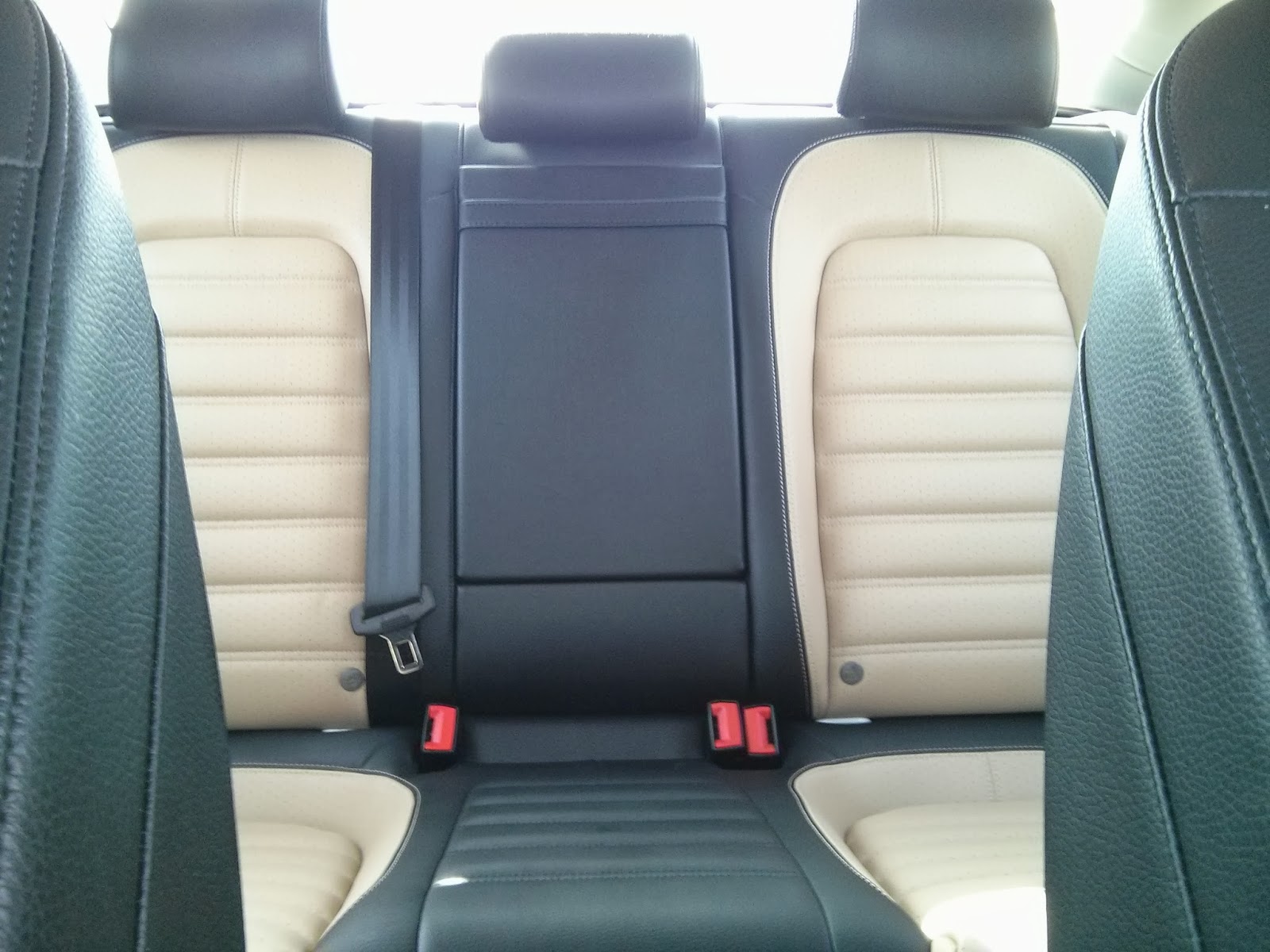
Inside, the premium air continues with typical high levels of German build quality, quite a step above the American-market Jetta and Passat. My 2.0T Sport Plus tester was decked out in a Desert Beige/Black leatherette material called V-Tex, a synthetic material said to be more durable than standard leather. Just tell your passengers it's leather and they won't know the difference. While most surfaces were buttery soft and premium feeling, some of the plastic aluminum accents felt a bit tinny and out of place in such a stylish cabin. The heated front seats are comfortable, supportive and power adjustable with good spacing for passengers. Rear accommodations are less so, befitting the CC's fashion-first mission. While leg space was just about adequate, my head touched the headliner and the amount of room wouldn't lend itself to comfortable three-abreast seating for anything above short trips. The seating position also places you low in the cabin with the window-line high up. Claustrophobia-prone passengers need not apply. Another thing regarding the rear seats: unlike the first-generation CC, the refreshed model now ditches the central rear divider for a slightly raised center seat, allowing a third passenger to ride.. The original two-place rear seating might have enhanced the look of the interior but many customers rejected the car because of the lack of a third seat. With this option, sales have picked up to the point where even the European CC now offers rear seating for three. However, even with this new feature, your three adult rear passengers will hate you after a road trip from Miami to Orlando. Small kids should be fine if they're not claustrophobic. Or you can just buy the Passat next door.


As the name suggests, Volkswagen's well regarded turbocharged 2.0 liter direct-injected four cylinder provides the motivation for this tester with output figures of 200hp and 207lb-ft of torque, channeled to the front wheels via a 6-speed DSG dual-clutch transmission. Now these figures might sound measly, but having driven a 2006 GTI so equipped, I wasn't in the least surprised at the ample power at hand. Where the 2.0T proved outright fun in the lighter Golf variant, in the CC it was more than adequate. Torque delivery is quite flat and readily available throughout the rev band, with just the slightest hint of turbo lag,  while shifts were typical-DSG smooth and imperceptible. At normal cruise, engine noise was kept mostly at bay with the only sound penetrating the interior being tire noise. While not deafening, it was noticeable enough but easily drowned out by the excellent 10-speaker sound system. Kick the spurs and the transmission will quickly ratchet down multiple gears to get the 2.0T in its sweet spot for almost instant forward thrust. Slip the selector into S mode and the transmission will hold gears all the way to redline, even anticipating a downshift when slowing for a corner. The driver can also take manual control via the gear lever, although for a car with the "Sport Plus" trim, paddle shifters are a curious omission. With a 0-60 time of just over 6 seconds, the 2.0T should satisfy the majority of customers.


While the CC is no sports car, it doesn't fall over itself when driven aggressively. Steering felt reasonably linear, losing some feel just off center. Ride quality when driven serenely is quite pleasant and solid, befitting its German roots. Despite the slightly stiffer suspension however, dive and roll when pitched hard into turns was substantial enough to tell most drivers to back off. The CC will change directions when asked as the steering is fairly responsive, but it prefers long sweeping turns as opposed to tight, twisty corners such as a racetrack  Don't feel like dialing it back? Terminal understeer will get your attention quite early when powering out of tight corners, spearing you into the weeds, even with the grip available from the larger tires (a summer option is available). I found a good technique when driving the CC aggressively was to carry speed into a corner, letting the chassis settle and allowing the tires to assist mid-corner. Once through with the nose more or less pointed straight, the throttle can be nailed and the mid-range torque of the turbo four can assert itself without understeer becoming an issue. Driven at 6/10s, the 2.0T provides enough thrust to keep the drive entertaining. Over that and the CC's Big Brother electronic nannies will quickly (and sometimes severely) slap your hand by aggressively cutting the engine and braking any slipping wheels. For the power-hungry, a 3.6 liter 280hpVR6 is available in uplevel models along with 4Motion AWD but the result would be a heavier and slightly more ponderous feeling (not to mention reduced gas mileage). Use the CC as a comfortable long distance cruiser and it will happily eat up the miles. Need more sport? VW has a GTI or Golf R with your name on it.


Pricing for the 2013 CC Sport Plus starts at $32,850 which includes the 18" wheels, RNS315 touchscreen with navigation, LED daytime running lights, Dynamic headlights with Adaptive Front Lighting and the good sounding 10 speaker audio system with Bluetooth phone/audio streaming while the DSG transmission replaces the base 6 speed manual. A fully loaded model with the VR6 and AWD will land somewhere in the mid $40k region. Audi territory. Choose your options wisely.


Competitors? Well there's the long-in-the-tooth Nissan Maxima, Ford Taurus, the new Chevy Impala and equally new Toyota Avalon as well as the Korean Hyundai Azera/Kia Cadenza duo. Another curious competitor to the CC could come from inside VW's own empire in the form of the Audi A4. While not as coupe-like as the CC (Audi has the pricier A7 for that role), the A4 does have a more premium nameplate and its base price sits at slightly less than $1000 more than the CC Sport Plus (although finding a base A4 with no options would be next to impossible). So is the Volkswagen CC worth the upcharge from the pedestrian Passat? If styling means more to you than practicality (really, isn't that why coupes are bought in the first place?) and a Mercedes CLS is out of reach, then Volkswagen has the car for you.


Many thanks to Mario for helping facilitate the review!